Turning medical device concepts into testable, manufacturable products.
From the first sketch to functional prototypes, we combine user needs, engineering, manufacturability and program leadership, so your prototype is the foundation for verification, design transfer and commercialization, not a one-off.
The decisions made early shape cost, timeline and success.
Product architecture, usability, materials, interfaces, tolerances, assembly approach and manufacturing assumptions are often set in the earliest prototypes.
We help translate clinical and customer needs into clear requirements, design concepts and functional prototypes. The goal is not a prototype that works once; it is a product foundation that moves confidently toward verification, validation, design transfer and commercialization.
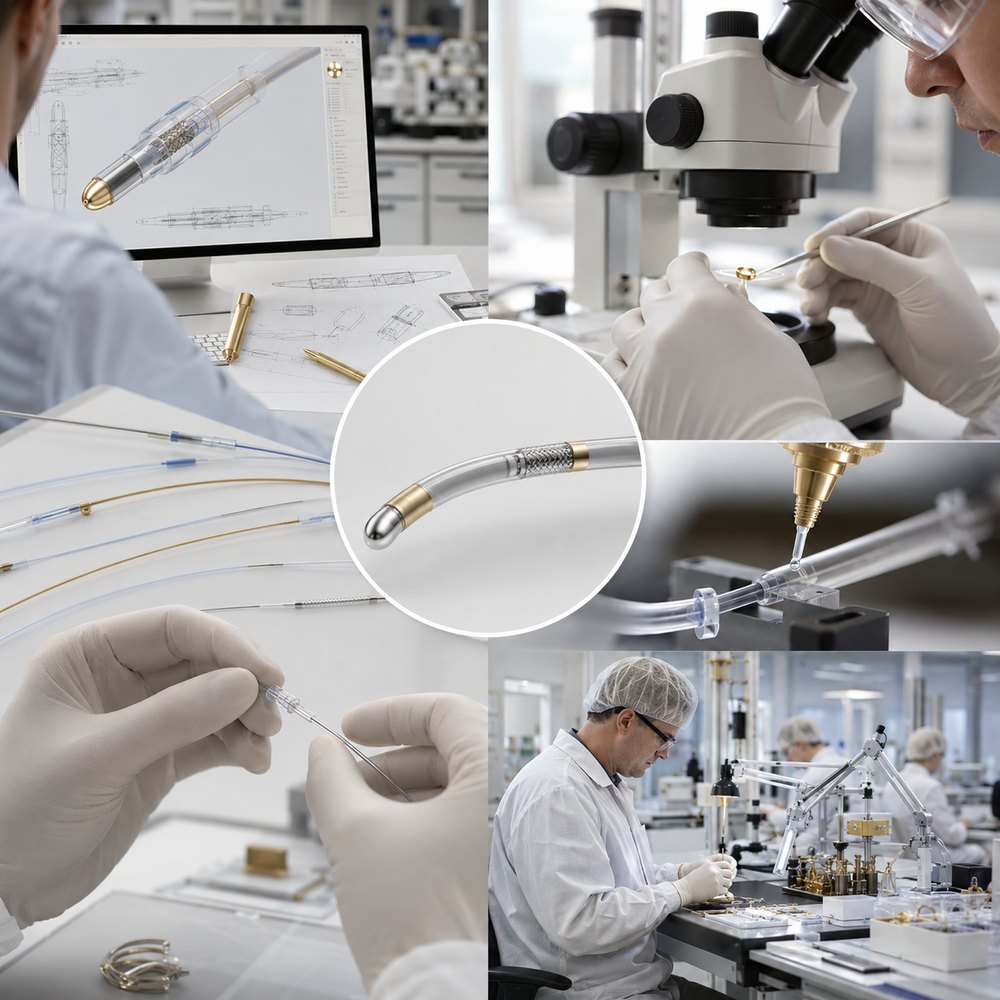
Product design and prototyping support.
Engage us for a focused portion of development or as a broader development partner.
01Define
- Product concept development
- User needs and intended-use definition
- Customer and clinical workflow evaluation
- Product requirements and design inputs
02Design & build
- Mechanical design and CAD development
- Proof-of-concept models
- Functional prototype development
- Prototype build planning and coordination
03De-risk & prepare
- Feasibility testing and risk reduction
- Design-for-manufacturability considerations
- Supplier and prototype vendor coordination
- Early manufacturing and assembly strategy
Four kinds of prototype, four different questions.
Building the right prototype for the question at hand saves months. Each step adds fidelity, documentation and cost, so we only add them when the evidence needs it.
Proof of concept
Rough, fast builds that isolate one principle or mechanism.
Functional prototype
Integrated builds that work like the product, tested on the bench and with clinicians.
Design-representative
Built to near-final design, materials and processes for formal and preclinical testing.
Production-equivalent
Made with production processes and suppliers for V&V, clinical builds and transfer.
Five principles behind every design program.
Start with the user need
Understand the clinical, customer and business problem before defining the solution.
Reduce risk early
Focus prototype effort on the highest-risk product, usability, manufacturing and performance questions.
Design for real-world use
Consider clinical workflow, handling, assembly, testing and manufacturing from the beginning.
Create a clear path
Connect early concepts to future requirements, testing, regulatory and transfer activities.
Build for scale
Make decisions with production, quality, supplier and commercialization needs in mind.
Projects we support.
Flexible support models.
Startups & small companies
A hands-on development and program leadership partner from concept through prototype, testing, regulatory readiness, design transfer and commercialization.
Established device companies
Focused support for concepting, feasibility, prototypes, design reviews, manufacturing strategy and execution.
Contract manufacturers
An embedded or fractional resource for customer programs, prototype builds, design transfer and scale-up within your quality system.
Common questions about prototyping.
More answers on timelines, FDA pathways and manufacturing in our general FAQ.
How long does it take to build a functional medical device prototype?
Simple proof-of-concept builds can take a few weeks; integrated functional prototypes usually take a few months, depending on complexity, custom parts and supplier lead times. A focused feasibility sprint is often the fastest way to answer the riskiest questions.
Can you design a prototype that is ready for manufacturing?
Yes. We bring design-for-manufacturability thinking into early prototypes, choosing materials, processes and tolerances that scale, and involving suppliers and contract manufacturers before the design is frozen.
Do prototypes need to follow design controls?
Early exploratory prototypes generally do not, but once you are generating evidence you will rely on for verification or submission, design controls and documentation apply. We help you draw that line deliberately so work isn’t repeated.
Who owns the intellectual property?
IP ownership is defined in the engagement agreement before any work begins. We agree it in writing up front, so there are no surprises later.
Can you work with our existing engineering team or contract manufacturer?
Yes. We regularly work alongside internal teams, outside suppliers and contract manufacturers, as a design lead, a reviewer or an embedded resource.
Turn your concept into a prototype that is ready for what comes next.
Tell us where the design stands today and the question you most need answered.